Fáilte, Bealtaine – Bring on the May!
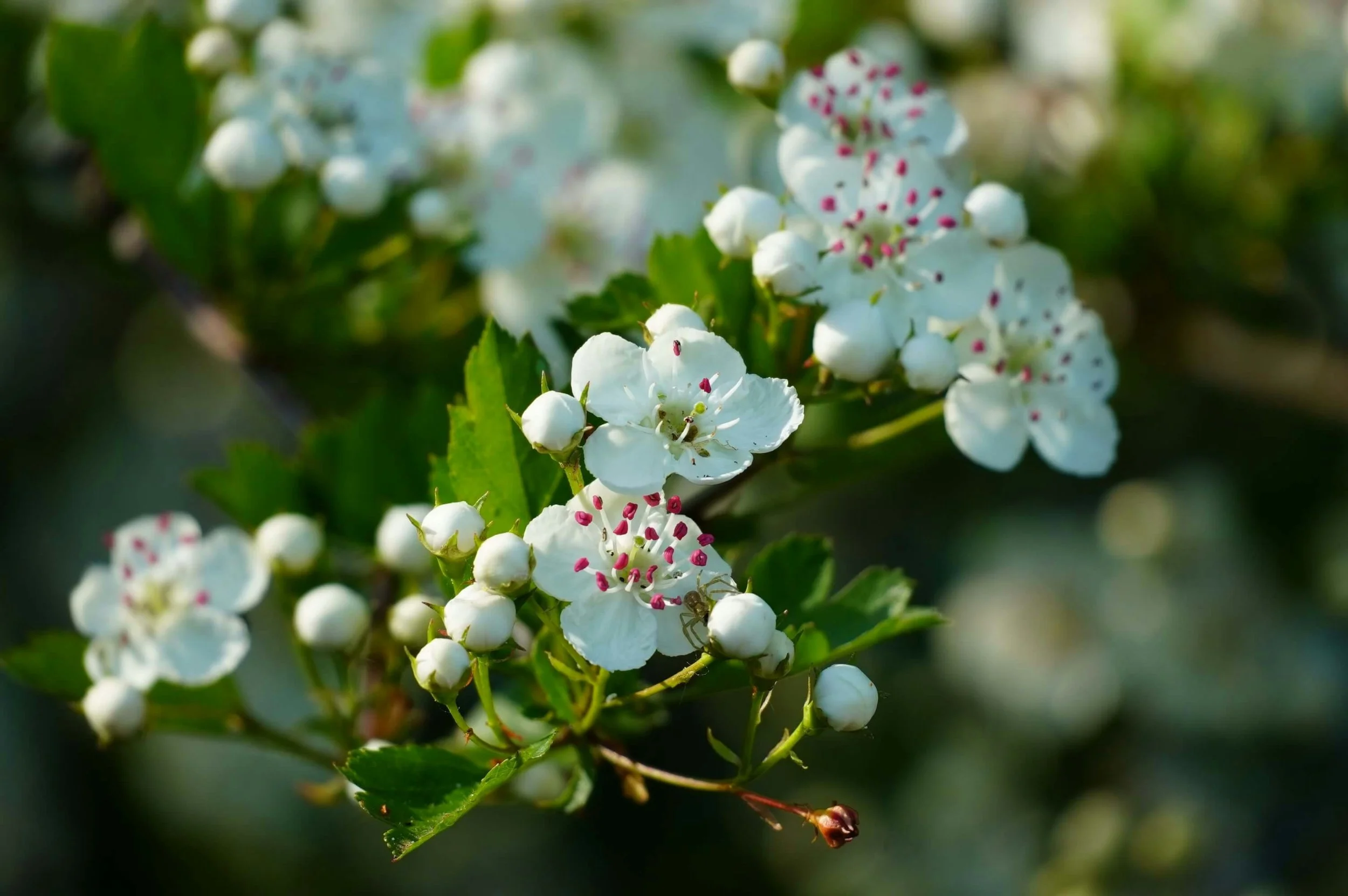
Image by Linus on Unsplash
Fáilte, Bealtaine – Bring on the May!
Shed ne’er a clout till May is out! Does this mean keep your kidneys warm till the month of May is done, or keep your coat handy till the May (Hawthorn) blossom appears on the hedgerows? You can choose which resonates most with you, or draw your own conclusions from that ancient wisdom. Another old way to find your way with and your path through, and maybe reclaim or kindle a ritual along the way, is Bealtaine (or Beltane). And it’s here!
Bealtaine is a cross quarter day in the old Celtic Wheel of the year, celebrated from dusk on 30th April till dusk on 1st May, because, for our forebears, each new day, like each new year, began with darkness, and thresholds, like most else in life, were important to mark with ritual. Bealtaine marks the midway point between the spring equinox and the summer solstice. It sits directly opposite Samhain (Hallowe’en) in the Wheel of the year’s turning, and is celebrated with fire.
Bealtaine comes in on the breath of darkness and reveals itself in the hinge of light, as the land inhales and the warming wind brings breath to wondering bodies, and summer whispers its readiness.
You feel it first in the bones—not as thought, but as a remembering older than language. A stirring under the skin, like roots whispering upward. The cattle once walked between twin fires on this night, their flanks brushed by flame and blessing, their breath rising like prayer into the soft blue dark. Fire was passage here, a threshold you walked through to become more fully alive.
The mythical goddess, Áine rises in the south, her hair a spill of sunfire over Cnoc Áine, the hill itself a breast of the earth, a reminder that the geography of our bodies was first, and is still, in the land. Twin fires mark the meeting of opposites— light and dark in liminal space and time. The Tuatha Dé Danann, those luminous beings of Irish myth, move close on this night, not as ghosts, but in energy and potency. The veil between worlds is not lifted so much as dissolved, like mist under morning light. You could step sideways, if you had the courage, and find yourself among these mythical beings, where time loosens its grip and every blade of grass hums with awareness.
When you stand barefoot on the grass at dusk, you might feel Bealtaine rise —not as a figure, but as an energy, a presence pressing gently at the edges of your certainty, asking: what are you willing to kindle?
There are fires still, if you know where to look
The fire festival celebrated at Uisneach, in the navel of Ireland, is dramatic, almost to the point of pageantry, and now welcomes thousands of pilgrims to the great fire on the hill, to the storytelling and the birdsong, to the redolent light. Its massive resurgence in recent years points to a hunger for connection and belonging, a fire in the belly for remembering who we are, and letting all of that blaze through us in cascades of light.
Not always the great communal blazes of old, but smaller flames, too, are important at Bealtaine, as an honouring of what we know in our bones but can’t quite remember: a candle set in a windowsill, a quiet intention lit in the heart, the spark that leaps when two beings meet, without armour or masks. Each one a Bealtaine fire. Each one a crossing.
And the body—your own body—is a kind of sacred hill too.
Breath moves through it like wind over bogland, slow and saturated. Inhale, and you gather the greening world into yourself. Exhale, and you offer something back—heat, longing, a fragment of your own wildness. This is yoga in its oldest sense: not just asana, but union, intermingling of the senses, the body, earth, breath, spirit, fire in the belly. Not striving, but a remembering that we were never separate from the turning of seasons.
Somewhere in the distance, a blackbird is singing, as if it cannot contain the sheer fact of being alive.
And maybe that is the teaching of Bealtaine.
Not just transcendence—but immersion. To step into the fire of your own life without flinching. To let the old stories burn through you, to fall back beyond words until what remains is both ash and ember—glowing, patient, ready.
So, you stand there, at the edge of night and summer, and you make your quiet vow:
to live as if lit from within.
Bealtaine: Between Fire and Water — A Yogic Encounter with the Celtic Threshold
At the threshold of May, something ancient stirs.
And, again, Bealtaine is not simply a seasonal marker. It is a moment of ignition. A crossing point where light overtakes shadow, where life does not cautiously emerge but arrives fully, unapologetically alive.
As Manchán Magan reminded us:
The old festivals were not about marking time, but about entering into it—stepping consciously into a different quality of being.
Bealtaine is precisely this: not an event, but an invitation.
The Fires of Becoming
The name Bealtaine is often understood as “bright fire” or “Bel’s fire,” and fire rituals stood at its heart. Across Ireland, great twin bonfires were lit, and cattle were driven between them to ensure health and protection for the coming season.
But to reduce this to agricultural practice is to miss its deeper resonance.
Fire, in this context, is threshold.
To walk between flames is to enter a space where identity loosens—where something of the old self is burned away, and something not yet fully formed begins to take shape. In yogic philosophy, this aligns closely with tapas—the inner heat of transformation, the disciplined fire that refines and reveals.
A Thinning of Worlds
Rather than reading all of this literally, we might understand how embracing our mythology gives us a shift in perception about ancient patterns still looping and old symbols still playing out.
We can see Yoga, at its core, as also a practice of thinning veils and blurring edges.
Through breath, stillness, and attention, we begin to experience reality less as a set of fixed boundaries and more as a field of relationship. Inner and outer, self and world, begin to soften.
As Manchán puts it
A threshold is not a line but a field—a place where the known and unknown overlap, and where we are asked to become porous.
We can choose to make Bealtaine such a field for ourselves – whether we’ve never heard of it before, faithfully mark it every year or have a vague echo that this is something we once knew.
Holy Wells: The Quiet Counterpoint
And it’s not all about the fire. Other rituals are important too. We can follow in the footsteps and vibrational energy of those who went before us and dance with abandon among the fires, or we can create and recreate our own rituals of belonging that resonate more fully in what is possible and meaningful for us today. While Bealtaine is often associated with fire, its deeper wisdom lies in balance. For every flame, there is water. As in yoga – always the holding of opposites. Neither one thing nor the other. Both. And.
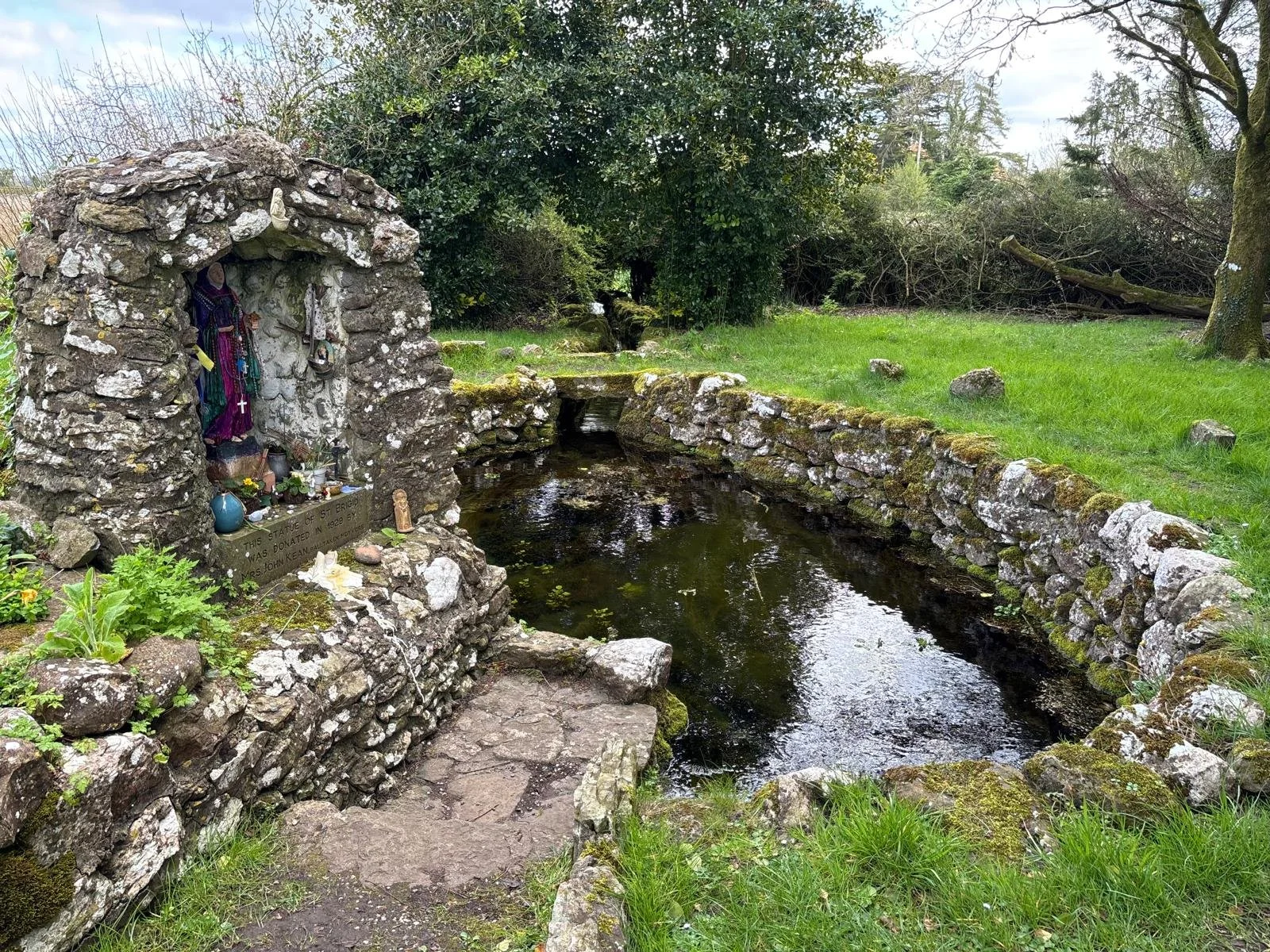
Ireland’s holy wells—ancient sites of devotion that long predate Christianity—were and remain places of pilgrimage at this time of year. At wells, such as St Brigid’s Well, near Uisneach or those closer to home, like St Cooley’s Well at Newtownards or St Olcan’s Well at Randalstown, people still gather to walk in quiet reverence, circling sunwise, offering prayers, and engaging in simple acts of washing, drinking, bathing and offering.
Water here is not symbolic—it is relational. It is kin. It remembers. Wells offer us a place to circumambulate our problems, to orbit around the depths of ourselves.
In yogic practice, the concept of saucha (purity or clarity) speaks to this same movement: a gentle cleansing, not through force, but through being present and open to different perspectives. Where fire transforms through intensity, water restores through continuity. Walking 7 times round a well, or 5 or 3 or 108, is not just a physical act. It helps us retrace the imprints of patterns in our bodies onto our psyches and invite them to reveal something fuller to us as spirit, body and mind entrain in the mesmeric moving around and around.
Together, these practices show us ways to let our purpose become clearer and the soul breathe towards wholeness.
The Body as Landscape of Belonging
And so, as in previous journal articles, we return to the body as geography, as the territory of our hearts. In early Irish thought, as in other indigenous cultures, the land was not an object but a living being—rivers were veins, hills - curves of a body, sacred sites - chakras, vortices, portals, energetic centres, etched into the landscape to meet moments of transition with ease. To walk the land and mark and remark the turning of the seasons was to be reminded to recognise our own selves moving within a rich elemental field of awareness.
Yoga offers us that same mapping and belonging as our practice takes us inward.
The body becomes a terrain of sensation and intelligence. The spine, an axis; the breath, a tide; the heart, a meeting place of opposite forces. Practices like prāṇāyāma awaken a sensitivity that echoes standing at a hilltop fire or beside a quiet well at dusk.
To return one final time, in this article, to Manchán’s wisdom:
“We do not stand on the earth; we participate in it. The same currents that move through soil and season move through us.”
Bealtaine reminds us of this nested intermingling and intertwingling with all that is, has been and is to come.
Living the Threshold
To engage Bealtaine today, then, is not, necessarily to reconstruct the past, but to enter the same quality of awareness through rituals that catch something of that energy.
You could light a flame or flick a light switch not as decoration or for pure functionality, but as intention. Sit with it. Feel what, in you, is asking to be ignited.
Visit water—whether a sacred well, a river, the sea - or even a bowl placed deliberately in your space. Listen. Let stillness gather.
Step outside, if you can, at twilight. Notice how the air holds warmth differently now. How the body responds without instruction.
Because ultimately, Bealtaine is not about ritual alone.
It is about relationship.
A relationship between fire and water. Between effort and ease. Between the seen world and the subtle one. Between the ancient rhythms of the earth and the quiet, living intelligence within your own body.
And at this threshold, the question is simple:
What, in you, is ready to come fully alive, step into the promise of Bealtaine and blaze and bloom into the summer coming?
Mary O’Rawe