
BHAGAVAN SRI RAMANA MAHARSHI
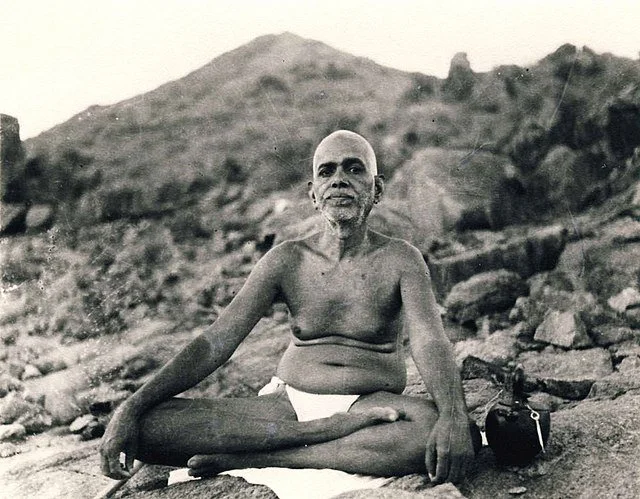
“O Arunachala, thou dost root out the ego of those who meditate upon thee in the heart”.
India has been blessed with an abundance of sages who, from time immemorial, have expressed the many faces of Truth in their lives and in their teachings. The Upanishads are disembodied voices from these times but are the accumulation of inner exploration and discovery by generations of rishis, each adding a golden brick to the living monument of “Sanatana Dharma” - the eternal truth that is ever fresh. Advaita Vedanta, the doctrine of unity of being, non-duality, is a central pillar of this monument. It encourages us to realise that ultimately there is only the Self and we are all expressions of It. Let us reflect on the life of the sage of Arunachala, Ramana Maharshi, the living embodiment of the great Vedantic utterance Tat Twam Asi meaning ‘You are That’.
Bhagavan Sri Ramana Maharshi was born in a poor Brahmin family in South India in 1897. The name given to him by his parents was Venkataramam, but when he unveiled to become the Self, he was known as Ramana Maharshi. Maharshi means great rishi, and rishi is another name for a yogi. Until the age of seventeen, his life was unremarkable. He was a popular youth who enjoyed sports, was indifferent to studies, and was not noticeably devout beyond the normal observance of the Brahminic religion into which he was born.
His father died when he was a boy, and it was in his uncle’s house, at the age of seventeen, that he had his great awakening, one day on return from school. A sudden awareness came over him that his death was imminent. I will quote Arthur Osborne:
He felt that he must face it alone. Lying rigid upon his bed, he tried to visualise, to dramatise death. He held his breath to make the experience more vivid, thereby unconsciously practising the technique of Pranayama or breath control. He said: “Well then, now death has come, what does it mean? This body is dead. It will be carried to the burning ghat and there burnt and reduced to ashes. But with the death of this body am “I” dead? Is this body “I”? All this was no dull thought. Vividly, the living thought flashed on him that he was not the inert body nor the thoughts that pass and are gone; he was the eternal “I”, the deathless Spirit. And in that moment death was dead, and he had awakened into enlightenment of the eternal Self. A lifetime of striving and sadhana was, for him, compressed into that brief moment. Theory he learnt later and recognised it, just as a woman who has borne a child might read afterwards about childbirth.
In his three reactions, he demonstrated an instant mastery of four ancient techniques of Yoga: pranayama; savasana; pratyahara and dhyana. He held his breath unto death; he willed the cessation of body functions, withdrawing the vital powers and settled into a corpse; and he stripped off the layers of his body/mind (Prakriti) to realise that he yet remained the eternal, living, fully conscious spirit (Purusha).
It is thus that Venkataramam became a “jivan mukta”, a liberated but embodied soul. Not one who attains samadhi or kaivalya (emancipation in unitive Being) and, invisibly, “slips like the dewdrop into the shining sea”, but one who lives in the higher realm of samadhi, and who lingers compassionately in the world to show us the Way. In this case, the ancient path of self-enquiry, Vichara, the “hunting of the I”.
One is reminded of Nachiketas in the Katha Upanishad who survives an encounter with Yama, the God of death, only to come away with a great realisation; this was surely an ancient foreshadowing of the coming of the great rishi.
For the young Venkataramam life could not be as before. He continued to attend school, but his mind was now increasingly drawn inwards; he lost interest in worldly things and would continually fall into bliss. He frequented the local temple, where floods of tears would flow from his eyes. Not long after, he left home; and set off, after the lure of the flute call of his karma, to the sacred hill of Arunachala, where he remained, a sage and king, until his death in 1950.
Swami Vivekananda once said that it is “a wonderful thing to be born into a religion, but a tragedy to die in one”; and by this he means that some are destined someday to break through the nurturing pot of form and to send our roots deep down into the underlying Reality.
And so it was with Venkataramam, who pawned his gold Brahmanic earrings, reduced his dress to what modesty required, shaved his head, and bathed in a sudden, felicitous shower of rain at Tiruvannamalai, at the foot of mysterious hill of Shiva. He repaired to an underground vault in the temple of Tiruvannamalai, and was immersed in the bliss of samadhi, oblivious to hunger, thirst, and the ravages of ants and vermin. Some respectful sadhus kept him alive, and eventually carried him, oblivious, to more congenial surroundings, to keep the boy yogi away from curious eyes.
Venkataramam eventually made his way to a cave in the hill of Arunachala and again continued long periods of silent kaivalya, occasionally writing answers to questions to the growing number of devotees who clustered around the young saint, seeking his darshan (sight of a holy individual, or to receive the “ soul-opening” glance from such a one). It was on one such day he received his title, from Ganapati Muni, a famous Tantric and poet of the time, and henceforth became known as Bhagavan Sri Ramana Maharshi. He taught in silence, but when he spoke it was with the greatest authority.
The remainder of the sage’s life was spent on the hill of Arunachala and later in his ashram in the vicinity. How can one describe Arunachala- and how can one write about the sage without pausing to reflect on his sacred abode! The Sufis declare that nature is a form of sacred revelation, and every spiritual tradition has its holy mountains, where the Gods and sages dwell. Arunachala, meaning “hill of fire or light” is described by the Puranas as the most ancient mountain on earth. Geologists have confirmed that the Deccan plateau was not part of the main body of Asia but is the remnant of a continent now lost in the depths of the ocean.
Many legends centre on Arunachala, in particular one where Shiva teaches Brahma and Vishnu a lesson in surrender “nobody can reach me by his own endeavour”, and declares that He shall “remain as Arunachala, the Hill of Light”. The Maharshi maintained that the mysterious hill is the form of Shiva, seen by the awakened, and not mere rock, rubble, dust and parched grass, as it appears to the profane consciousness. Intriguingly, the hill was his guru and form of the Divine, and the object of his bhakti devotion. It was a Shiva lingam, and a hill of wisdom. Others refer to Shiva having taught there in deepest antiquity, transmitting in silence, “Dakshinamurthi”, and indeed Bhagavan attested to this himself. All of this is only amenable to reflective meditation.
Arthur Osborne says: “there is a legend that throughout the ages Dakshinamurthi has been sitting under a huge banyan tree on the north slope of Arunachala, in a spot inaccessible to climbers and that his silent upadesa would bring realisation to any who approached him”. He further observed that the legend has now been crystallised in the life and teaching of Bhagavan, and that what was once inaccessible is now opened up as the path of self-enquiry. Bhagavan described Arunachala as the spiritual centre of the world, and to many seekers it is a precious Mecca.
This writer has climbed the hill also, but like many others, it has only gradually worked its spell on him, and in reflective moments and in meditations, the image of Arunachala and its sage come into his mind and heart.
For those who wish to walk the sacred hill, or visit Ramana Ashram but have neither the means nor opportunity, Arthur Osborne has this to say. “Dakshinamurthi has moved down to the foot of the hill. He said “I am not going away; I am here. He is here at Tiruvannamalai as before and at the same time he is spaceless Arunachala-Ramana, here in the heart of every devotee who turns to him, guiding them as before”.
We must of course talk about the Maharshi’s teachings, which of course were pure Advaita Vedanta, and in fact his entire being was the teaching. “A-dvaita” means “not two” – the “One without a second”. According to Vedanta, God (Brahman) is the essence and principle of everything, and all manifestation and diversity is nothing but appearance. Even our waking existence is said to be nothing but a dream, and the ego and personality we hold so dear nothing but an illusory continuum of so-called experiences that mask our true identity. This is part and parcel of Gyana Yoga, but from it came the practice of Viyoga (separation), whereby Gyana yogis engaged in a form of meditation which involved systematically separating those parts of our being which were not the essential, authentic Self.
Ramana Maharshi developed this further, in what Arthur Osborne described as a direct path for the modern age. The sage advocated that we continually ask “Who am I?” As thoughts arise, one should not be drawn by them, but ask: “what is the source of this thought? To whom is it happening? To me- but who am I?” As each thought disappears when so scrutinised, it returns to the “I thought”. There is no ultimate answer to “Who am I”, as “it dissolves the subjective, “I thought” which is the parent of all thoughts, and comes from an area where thought is not.
Arthur Osborne says of this process: “no answer the ego can give can be right. The Self transcends thought and words. The ego is seeking what is before its origin and beyond its source, and the answer will not be grasped by it but will grasp and devour it”. As we practise this method of self-enquiry, a current of primordial awareness awakens in the heart, “a feeling of the essential “I” in the heart, who is the universal Self, unaffected by good or ill fortune. The use of this vichara destroys the “I am the doer illusion”.
There are many other wonderful things, known and unknown, which could be said about the Maharshi, but words would fall short before his majesty. He renewed for this age of Kali Yuga the primordial path of Gyana Yoga, while upholding the other paths of Yoga which belong to this world of form, and the many faces of truth. He was the supreme contemplative, an immaculate lotus flower in an age of striving, getting and spending.
“Sri Ramana was, as it were, the incarnation in these latter days and in the face of modern activist fever, of all that is primordial and incorruptible in India. The whole of the Vedanta is contained in the Maharshi’s question “who am I?”; the answer is: the Inexpressible”.
Frithjof Schuon
We are indeed blessed that such a great Yogi was born in our age. His life was a reminder that the great paths (marga) of Yoga remain ever fresh. His shrine and ashram under the sacred hill of Arunachala remain a beacon light to all who continue to seek Arunachala in the heart.
Yogacharya Michael McCann
