
Imbolc: the return of the light
There is an old remembering that time was once kept not by clocks or calendars, but by light and land. By the slow breathing of the Earth. In the Celtic wheel of the year, the dark half and the light half face one another like twin lovers, meeting at the solstices. Between them lie the equinoxes, moments of balance, and between those again the liminal thresholds of cross-quarter days — the fire festivals — when something turns, quietly but irrevocably.
These were not only days of celebration and ritual, but legal days. Days when people gathered. When agreements were made, cattle traded, labour hired, reckonings rendered. When it made sense to take stock, because we were already together, already listening, already awake to change. There is wisdom in that: transformation needs witnesses.
Imbolc is one of those days. Traditionally marked on the first of February, it links to the beginning of lambing, the first milk in ewes’ udders, and the sense that something new is growing beneath the earth even where frost still lingers. The word Imbolc relates to this “in the belly” time when life returns to the herd and the fields
Imbolis not yet birth, but the undeniable fullness of what is forming. The Earth’s belly is no longer empty. Something has shifted. The light has begun its slow return, calibrated gently, not all at once.
Imbolc has long been associated with Bríd — goddess, saint, or something more porous than either. The Christian calendar folded her into sainthood as so often happened, but the older current runs on underneath. Whether Bríd was once a woman of flesh and bone or a figure shaped by collective devotion matters less than the energy she carries: fertility, healing, poetry, craft, protection. Fire and water held together.
There are the old customs.
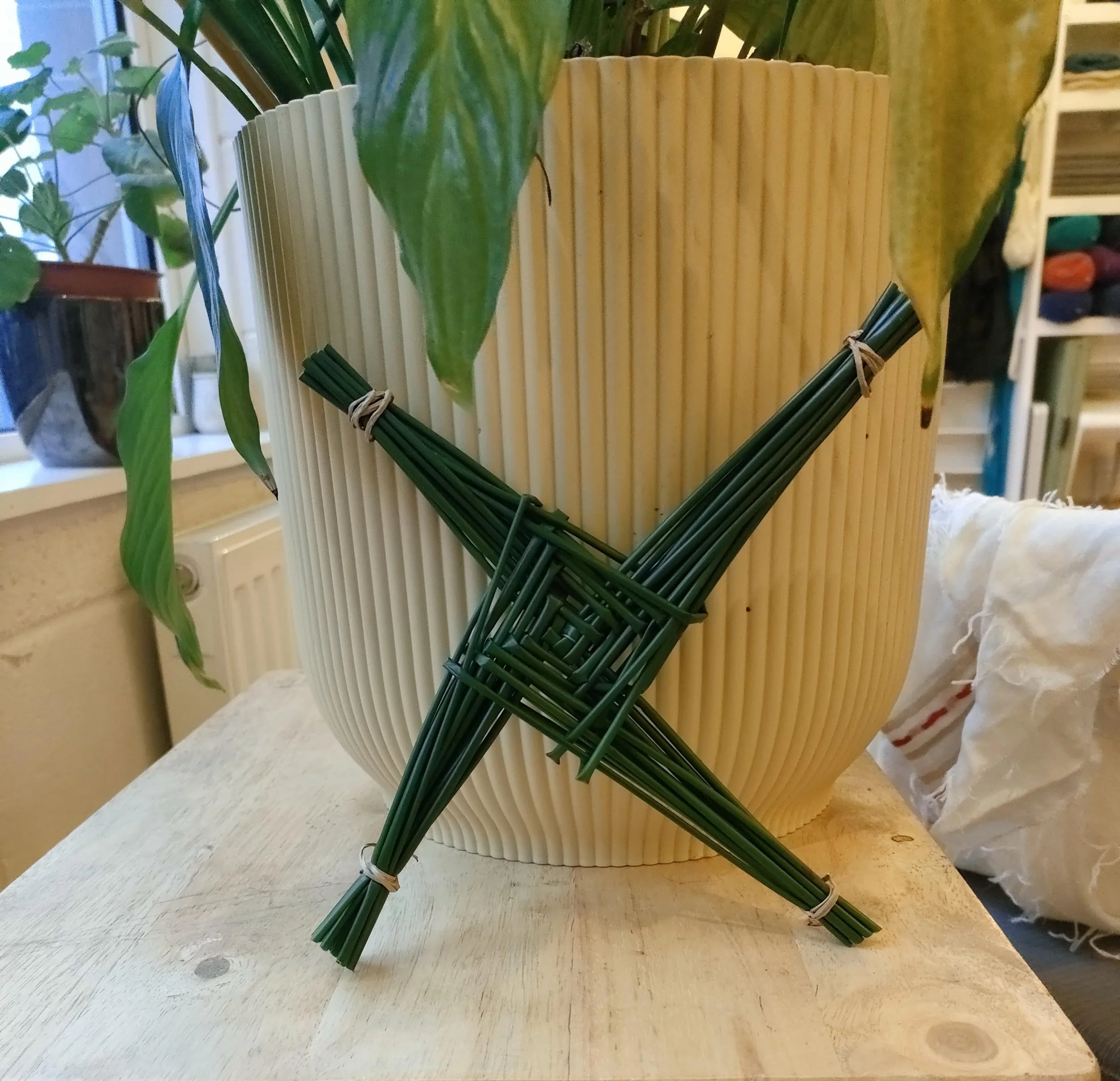
Brigid’s day was an important folk celebration: a day for weaving crosses of rushes, visiting holy wells, tending hearth fires, and marking the promise of spring with community feasts and rural rituals.
A Brat Bríde — a strip of cloth or lace — left out overnight to be touched by her blessing as she passes, taking over from the Cailleach, bringing the spring, can later be used for healing the eyes. Knickers left on the line on Bríd’s Eve, are whispered to bring fertility. You can dismiss these as superstition, smile at them fondly, or wonder — not whether they are literally true, but whether they are invitations. Invitations to pay attention. To ask: What might I be able to birth this year, if I tend what is fragile rather than forcing what is not ready?
Imbolc does not roar. It whispers. And that whisper can be a profound relief — especially for those who suffer through the dark months, whose bodies and minds struggle without light. Seasonal affective disorder is not a failure of resilience; it is a reminder that we are elemental beings. We need the sun. We need cycles. We need reassurance that winter does not last forever.
And so the first green spears push through the soil. Snowdrops, crocuses, the faintest swelling of buds on bare branches. The light lingers a moment longer in the evening. There is, perhaps, just a little more lift in the step.
Modernity encourages us to forget this. We live in boxes, stare into boxes, schedule our lives in boxes. I laughed when my phone autocorrected Imbolc to inbox. It says everything. The lie is a relentless distraction from what we’ve forgotten: it tells us that we are separate from land, immune to season, linear creatures who begin and end rather than participants in a great turning.
But our bodies know better.
Imbolc asks us to take stock — not in the language of productivity, but of energy. What has winter taken from us? What has it given? What needs replenishing before we step into spring? This is not the time for grasping or striving, but for setting intention with humility. Life is still tender.
There is also lineage here. A remembering that stretches behind us and ahead. People like Manchán Magan — who spent years reclaiming ancient lore, teasing language back into relationship with land and us — remind us that knowledge is not abstract. It is entangled. And one day, inevitably, like Manchán and his ancestors before him, every carrier of such remembering will pass. When that light goes, something is lost — but something remains in the belly, in the bones ready to spring new again - embodied, lived.
That is the real work of Imbolc. Not nostalgia, but transmission.
Like yoga, when it is more than fitness. Like breath passed from teacher to student, altered but unbroken. An ancient thread, reclaimed and made useful for the lives we are actually living now. Not as reenactment, but as relationship.
We were born on this soil, this one earth. The light returns, in its own time, with its different traditions and cultures, everywhere. One land, many tongues. One rhythm, endlessly re-expressed. We are not outside the cycle. We are the cycle, briefly conscious of itself, at the fire festival of the turning seasons.
And so we practice.
An Imbolc Yoga Practice: Birthing the Light
This is a gentle, inward-listening practice. Think tending the hearth, not stoking a blaze.
If you wish, light a single candle or seven or a number that has significance for you.
1. Breath Awareness
(Rooting, Nervous System Reset, Integration)
Begin in savasana — lying on the back, legs comfortably apart, arms resting slightly away from the body, palms facing up , fingers, like buds, gently curled
• Let yourself be held by the ground, like a seed cradled by soil - about to do great things
• Begin a soft awareness of natural breath, without altering it. See if you can breathe the exhale back to the ground beneath you
• Gently begin counting the breath in and out: inhale naturally, for maybe a count of four or five then exhale slowly to a count of 6 or 8 or 10 letting the body soften more each time, gently surrendering a little more to the reach with each breath.
• You could silently repeat: “I am supported. I do not need to push.” ‘I feel the light return’ an enlivened mantra or any other phrase that seems right for you in your life right now
Remain here for 10-20 minutes. Don’t shortchange yourself - never skimp on shavasana - remember to place emphasis on relaxation as a discipline, not an afterthought — a necessary condition for transformation.
2. Intuitive Practice (Somatic, light reclaiming Earth-Honouring):
• Come to all fours, knees wide, hands grounded, fingers spread as if feeling into the earth
• Begin gentle circles theough the pelvis and spine , like something stirring within soil.
• Move into cat-cow but slow it down, letting the movement ripple and gather its own momentum.
• Lower into Child’s pose, (balasana) arms extended or wrapped back toward the feet, forehead resting — a small acorn in the earth ready for the light.
• Rise slowly when you’re ready onto the knees with arms reaching overhead into candle pose. Let your arms dance as you grow upward and welcome back the light. Pendulate from candle and back to cat cow, or child pose or full pranam, prostration on the ground and back as many times as feels right - from earth to light and back to earth
• To finish, you could come into a low squat (malasana) hands at your heart or resting on the earth, feeling the pelvis as a bowl.
• Ask silently: What is forming in me? What needs patience rather than pressure?
Move intuitively for 10–15 minutes.
Closing Ritual
Return to stillness. Back to savasana - where you began. Place one hand on the belly, one on the heart.
Whisper or think:
As the light returns to the land, may it return to me. May what is forming be tended with care. May I move in rhythm, not resistance.
— them.
Imbolc needs only your presence and soulful awareness to make its energy felt. The light is coming back. So are we.
Mary O’Rawe
