
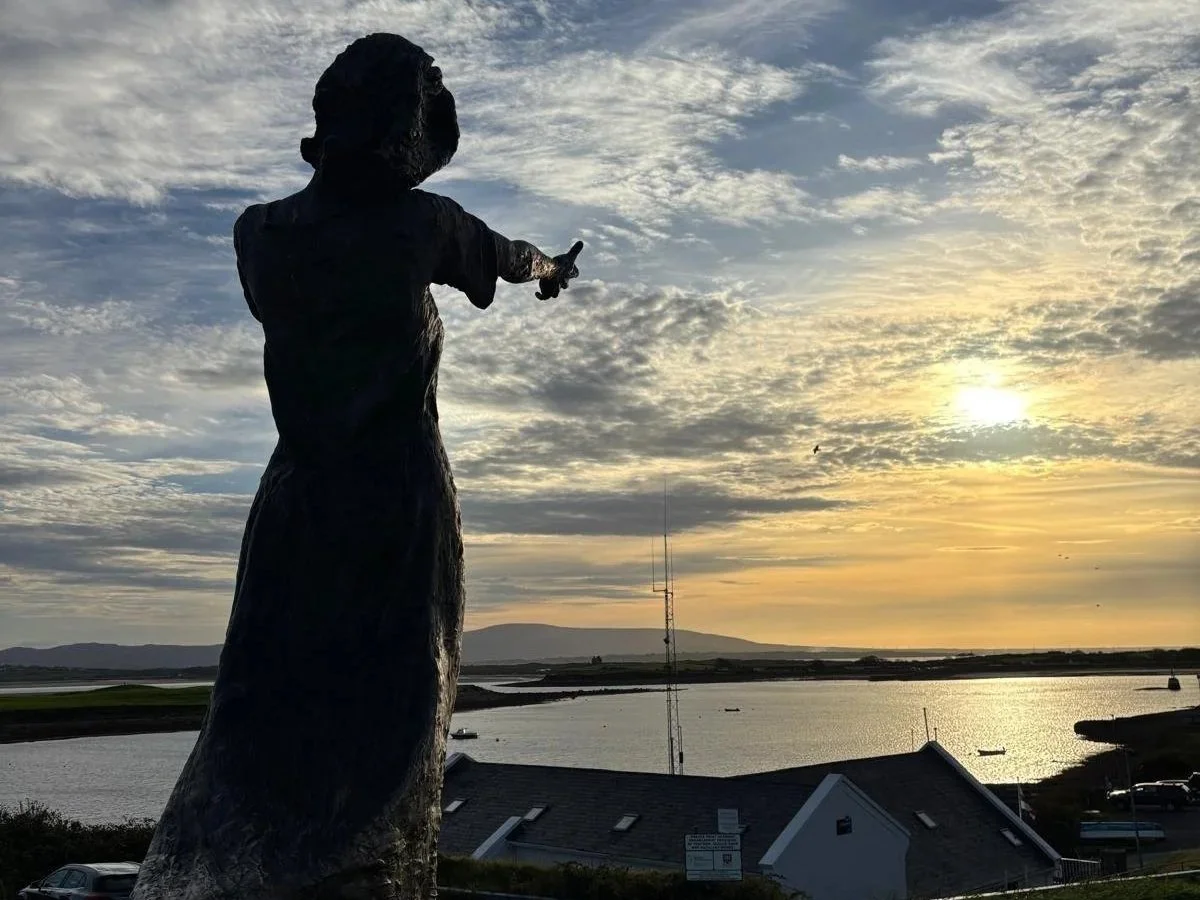
Photo by Mary O’Rawe for The Yoga Fellowship NI
…and as a way of making the future.
Samhain (Summer’s end) is upon us. We can deny it no longer. The dark half of the year is finding ways to really settle in our bones and ways of being. People are putting up Halloween decorations. The leaves are flying and whirling in the orange gold of autumn. The nights are drawing in and the earth getting colder (though maybe much less cold than in previous years, as the whole world heats up). Samhain provides another one of those remembering times of the year, a time for resetting and recalibration of rhythms, of being more fully with an earth coming to rest. Blinds and curtains are drawn earlier. Words like cozy and warm have a different appeal. Stews and soups call much more definitively than salads and lite-bites. Increasingly, there is a draw to remembering what our ancestors did at times like this, and a pull towards our dead and otherworlds.
There is a rich dark beauty in us meeting Samhain as so much more than simply a festival that harks back to the past, puts on masks and gives out sweets. It can become a practice through which past, present and possible futures meet - and through which we recover the capacity to inhabit our world differently. The growing darkness means we can’t see clearly what comes next, but it gives us room to listen for what might.
There’s yogic tradition that suggests the importance of spending our life meditating on the question who am I? Origin stories are important - they’re part of the mythological underpinning of society and culture through time. Where do we come from? Why are we here? Who even am I?
And increasingly, science is understanding what ancient wisdom traditions have always known - we are, if anything, unfolding processes, nested within other unfolding processes going back, back, back, further than time and also sparking into the future, whatever the future is.
More than we can understand, life is shrouded in mystery, enchantment and magic that empirical science will never fully open the door to. We are linked into natural, repeatedly unfolding cycles of life, death and rebirth. The poets are helpful here. Seamus Heaney speaks of a childhood endlessly fascinated by wells, looking deep into tangled roots and water to see his own image. All he knows is that ‘door into the dark’ and a pressing need to ‘rhyme to see myself, to set the darkness echoing.’
Seamus, also in his poem, Postscript, talks of human beings as ‘neither here nor there; a hurry through which known and strange things pass. It’s useless, he tells us to think we can park and capture the elemental power and beauty of nature further - ‘as big strong buffetings come at the car sideways and catch the heart off guard and blow it open.’
Samhain is a recurring opportunity to have our hearts blown open – to ask what we have inherited, what remains unfinished and what we are prepared to make possible together. We remember, not because the past is over, but because, as yoga helps us understand, the ways we remember determine what we can imagine, and what we are able to change in the present.
As we move into the Fellowship’s 50th year, we, on the committee, see a real possibility for the Fellowship to continue to develop something distinctive: a form and celebration of yoga practice rooted in local landscape, embodied attention, stories of place and the difficult work of collective memory. As in 1977, when Fellowship teachers brought yoga into schools and communities in interface areas, we want to continue the legacy of yoga not as escape from history, but as a way of becoming more present to the histories, relationships and material conditions in which we live. In this context, folklore becomes the encoded wisdom of ordinary people, and storytelling a way of bringing those and other perspectives into the present.
‘For the Ancient Irish, the land was not mere earth; it was a murmuration, an ancient incantation. It would make sense to think of it as consecrated, a realm where gods lingered and the dead brushed against the living…it was infused, a nexus of divinity and enigma where the corporeal world blurred into the arcane.
For the Celts, the land bore spirit - not metaphor but a literal anima, a breath of divinity in each hill and vale. The "thin places" of the Irish Celts were fault lines of reality, places where the Otherworld could encroach, where gods and fairies wander. They included a variety of places, hills and mountains, pools, lakes, and rivers, as well as clearings in woods and fairy rings (mushroom rings), certain trees, and so on.
Of course, as people who lived at the mercy of the weather, they had to learn to live in tandem with earth's great pulse. The passing seasons were marked with ceremonies, and the cycles of decay and renewal mirrored the soul's own spiral.’
Paddy Murphy “A Look at the Elements of Ancient Celtic Mysticism.” Medium, 2024
What we know of what it means to be human suggests a continued need for gathering and rituals and seeding questions that are more than a celebration of Celtic heritage or an opportunity for personal reflection. Samhain invites a practice of collective remembering, decolonial imagination and future-making.
The crucial question becomes not simply: What do our ancestors have to teach us? but: What becomes possible in the present when we allow ourselves to remember differently, more fully and more deeply what it might mean to be human - and what are we willing to change because of what we remember?
The fact that the dead and the unseen enter the imagination more fully at this time of year, and that the old year ends, while the new year begins in a darkness, far ahead of the promise of spring, is already a challenge to the dominant story of time.
We tend to imagine time as a straight line: the past behind us, the present passing quickly, the future somewhere ahead. We treat history as something completed, memory as looking backwards and progress as moving forwards.
Yoga questions this separation. It explores how past and future are active within the present, how our stories shape and are shaped by collective memory, and how revisiting and recircling those stories with fresh eyes can create room to imagine different ways of living.
The ancestors are not merely behind us. They are present in the languages we speak and those we don’t, the places we inhabit, the institutions we inherit, the ways we relate to one another and the possibilities we can - or cannot - imagine. And the future is not simply waiting for us. It is being rehearsed in our sankalpas, and our habits, relationships and choices now.
The darkness and ritual of Samhain can therefore become an imaginative pause: a refusal to rush from what has happened to a set account of what must happen next. We can pause. We can listen. We can ask what the past is doing in the present. And we can make space for a future that is not simply a repetition of what we already know.
Mary O’Rawe
