
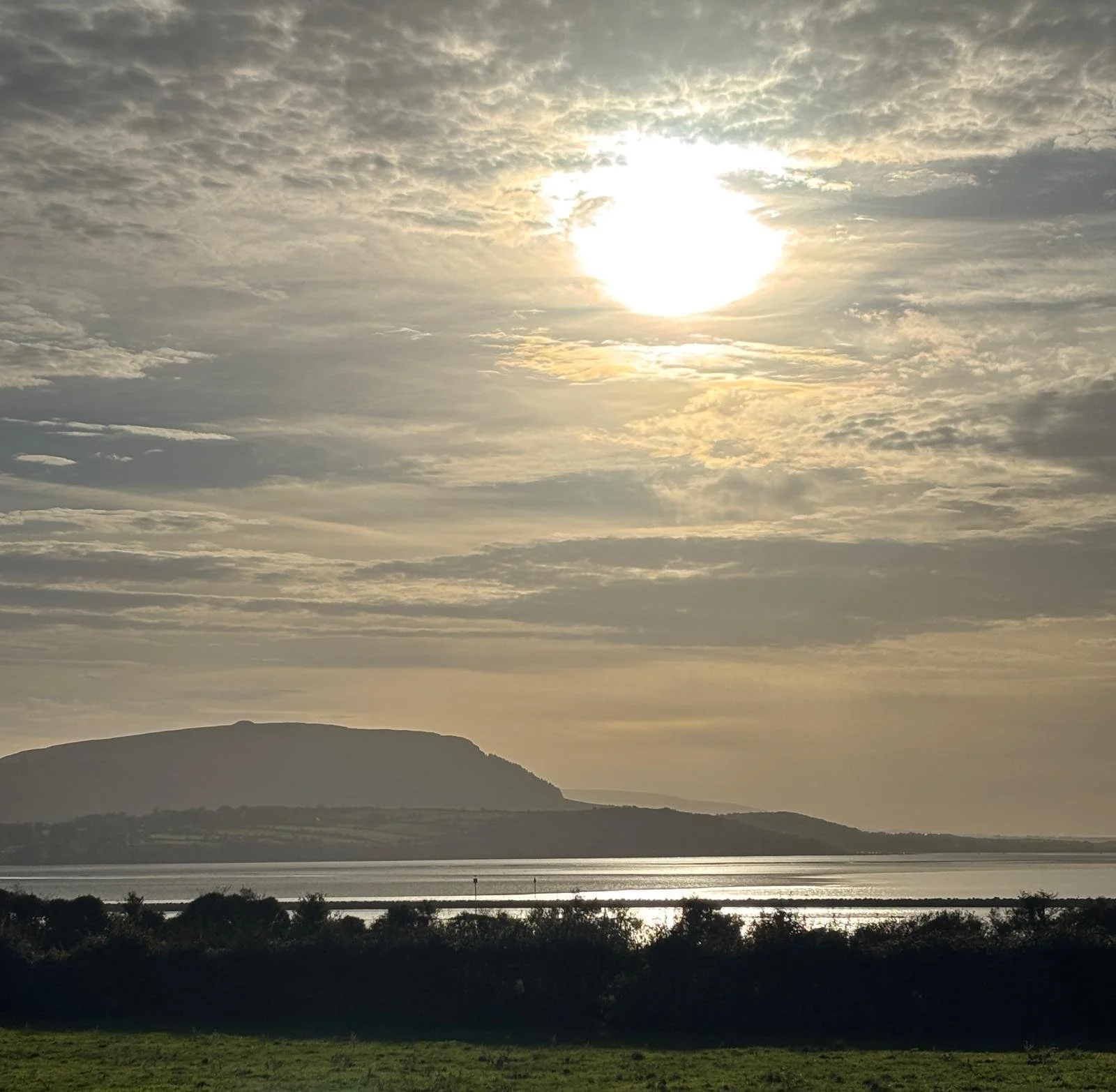
Photo by Mary O’Rawe for The Yoga Fellowship NI
The particular venue we chose for our Samhain gathering this year is much more than a beautiful backdrop. Belfast Castle carries at least two distinct histories that should be held together without collapsing them. The earlier castle, built by Sir Arthur Chichester in 1611, belonged very much to the Plantation-era transformation of Belfast. The present building was commissioned by the third Marquess of Donegall in 1862 and completed in 1870. It subsequently passed to the Shaftesbury family and was gifted to the city in 1934.
The architecture can sanitise or romanticise the colonial history from which the family's position emerged – it is simultaneously a product, a process and interpretation of that history and, for that reason, as well as its location in a liminal space, an ancient hill, a high place where earth meets sky, and both contains and overlooks water, it offers fertile ground for meaningful ritual.
It is an important place to ask what happens when we become conscious of the stories a place tells, the stories it leaves out, who and what has been eclipsed and rendered invisible and the relationships of power that have shaped who belongs, whose knowledge counts and what is remembered.
A building can be beautiful and still carry difficult histories. A place can be loved without its history being sanitised. The castle, and indeed this land, raises a significant question for those of us living in this part of the world - Can we belong to a place without needing to make its history innocent, grandiose or all one way, telling only the stories in our communities, in our bodies and on our breath, that it feels comfortable or tortuous to hear?
A ritual of listening to place
When we gathered in the Castle on 1st November and practised yoga in its rooms – we were steeped not just in its ornate beauty, but in its materials, its scale, its symbols, its histories, its contradictions, it sense of permanence. It is so clearly, like ourselves, a place that holds, and has room for, more than one story.
This building carries the imprint of people, wealth, ambition and power. The land beneath it holds histories of blood that reach further back than the building itself. We cannot recover every voice that has been lost, and we should be wary of pretending that we can speak for those who are no longer here, but we can ask what has been remembered, what has been forgotten, and which accounts of the past have been allowed to predominate. We can wonder how what has been rendered invisible or dismissed as irrelevant shows up in our bodies? We can reflect how lived experience is revised by how we do (or do not) collectively meet the past that still lingers among us. We can ask what if the past has not finished happening?
What if a colonial relationship survives in the organisation of land, in our understandings of property, ownership and consumerism – in what gets named, whose expertise is trusted; in the destruction of habitats; in the economic choices that shape everyday life?
What if a family story continues to shape how someone inhabits the present, even when the original happenings occurred generations ago?
To remember differently is not to rewrite the facts to suit our wishes. It is to notice that the meaning of the past is continually being made in the present - and that different voices, encounters and practices can change what we understand and what we do next.
This is why ritual matters. It creates a different kind of space, a little out of ordinary time, in which to encounter what ordinary routines often push aside.
Samhain offers a pause in the habitual flow of life. It gives us permission to turn towards endings, ancestry, loss and the unknown. It can bring together stories that are usually kept separate: personal and collective, intimate and political, remembered and forgotten.
And it can ask us to imagine a future not constrained by the assumption that the world must continue as it is.
What is present here is body, land, spirit, place, the inherited world. We can begin with the ground, the body, the castle and the landscape. What is supporting us? What histories and relationships are already present, whether we notice them or not? What is finished here and what remains unresolved? What is still being transmitted through ancestors, mythology, memory and silence? Can we bring the Cailleach, the stories of land, family and community memory, the castle's histories and the things that have been silenced or lost? Can we bring what is swirling, stormy, joyous and uncomfortable in our own body-mind-spirit? Can we bring this all into conversation with yoga through storytelling, sounding, ritual, deep listening and what happens in the magic after silence?
This is where intention-setting becomes more than an affirmation: in some ways it can weave a spell of opening towards a different way of living. Yoga tells us that intention is not necessarily a wish for something in the distant future. It can begin as a way of inhabiting the present. In this context, the future is not simply a destination. It is a field of possibilities that can be obscured by habitual ways of thinking and living.
So rather than asking only, what do I need most at this turning of the year, can we first lean into remembering and unremembering, what have I inherited that is still alive in me? It might be a gift, a wound, a story, a habit, a silence, a way of belonging - or something that has never been spoken.
Then can we imagine together what becomes possible if I no longer have to repeat the familiar story or the one that feels it’s always leaving something out?
We don’t need answers – just to leave enough space for something else to form. It might be a new relationship, a different response to a familiar question, a more generous approach to community or to rest, or a way of caring for the land.
Yoga asks us can we embody all of this? What can we begin to practise now, so that this possibility has somewhere to live? Can we find a small, present-tense expression rather than a grand promise? Can we create space to listen inwardly? Can we make room for stories that have not been heard? Can we listen before we assume we know? Can we learn the names of the places that hold us in a different way? Can we practice a form of care and compassion that can be seen in what we do and how we feel and speak to ourselves inside? Can we allow what has ended to be mourned without forcing any premature conclusion? What kind of world would become possible if more of us practised this?
That is the movement yoga offers: from individual wellbeing towards collective future-making in each present moment infused by the past.
‘To arrive where we started and know the place for the first time…’
T.S. Eliot
If remembering and imagining are already part of human life, why ritualise them?
Because everyday life is organised around repetition, productivity and forward movement. We often know intellectually that history matters, that relationship needs attention or that our habits are damaging something, without allowing that knowledge to change how we live.
Ritual creates a deliberate interruption. The point is not that ritual has supernatural power to repair history. Nor that a gathering can resolve colonial legacies or collective trauma in an afternoon. Its power is more grounded and, perhaps, more demanding: ritual can help people attend, remember, feel, imagine and practise together.
Samhain is especially suited to this because its seasonal symbolism makes space for ambiguity. It allows us to inhabit a threshold. It gives us a door into the dark.
That threshold can be used to rehearse a different relationship with time: one in which the past is not sealed off and the present not merely a corridor to somewhere else.
Our Samhain gathering invites us to arrive in this place, at this turning of the year, to listen to the land, to stories carried through time, to the things we remember and the things we may never fully know. We are not looking to resolve the past or answer every or even any question. Nor are we making ourselves innocent of the histories we inherit.
But perhaps through listening to stories, bathing in sound and weaving our own spells we can make a little more room: for other voices, perspectives, and possibility.
The past is not ours to command. Yet how we remember it matters. The future is not ours to possess. Yet what we practise in the present helps make it possible.
So, as we encounter Samhain this year, may we find other ways of going round the doors. May we carry the flickering light of a question worth living with as the winter comes through. May we listen more deeply to the places that hold us. May we make room for stories that enlarge our understanding of one another and what it even means to be a relational human entangled with time, space and otherworlds. And may something of all of this find its way into the ordinary choices through which we make our world.
Perhaps the most important measure of our gathering at Samhain, if one were needed, might be not whether people leave feeling transported, peaceful or moved from an afternoon of storytelling and bathing in sound. It will be whether something we encounter there casts its own spell and continues to permeate how we listen, how we relate, what we notice about the land, and what we are willing to do differently in our practice of becoming more fully alive, among our ghosts, and our ongoing living with our dead.
Mary O’Rawe
