
The Mystery of Lord Ganesha
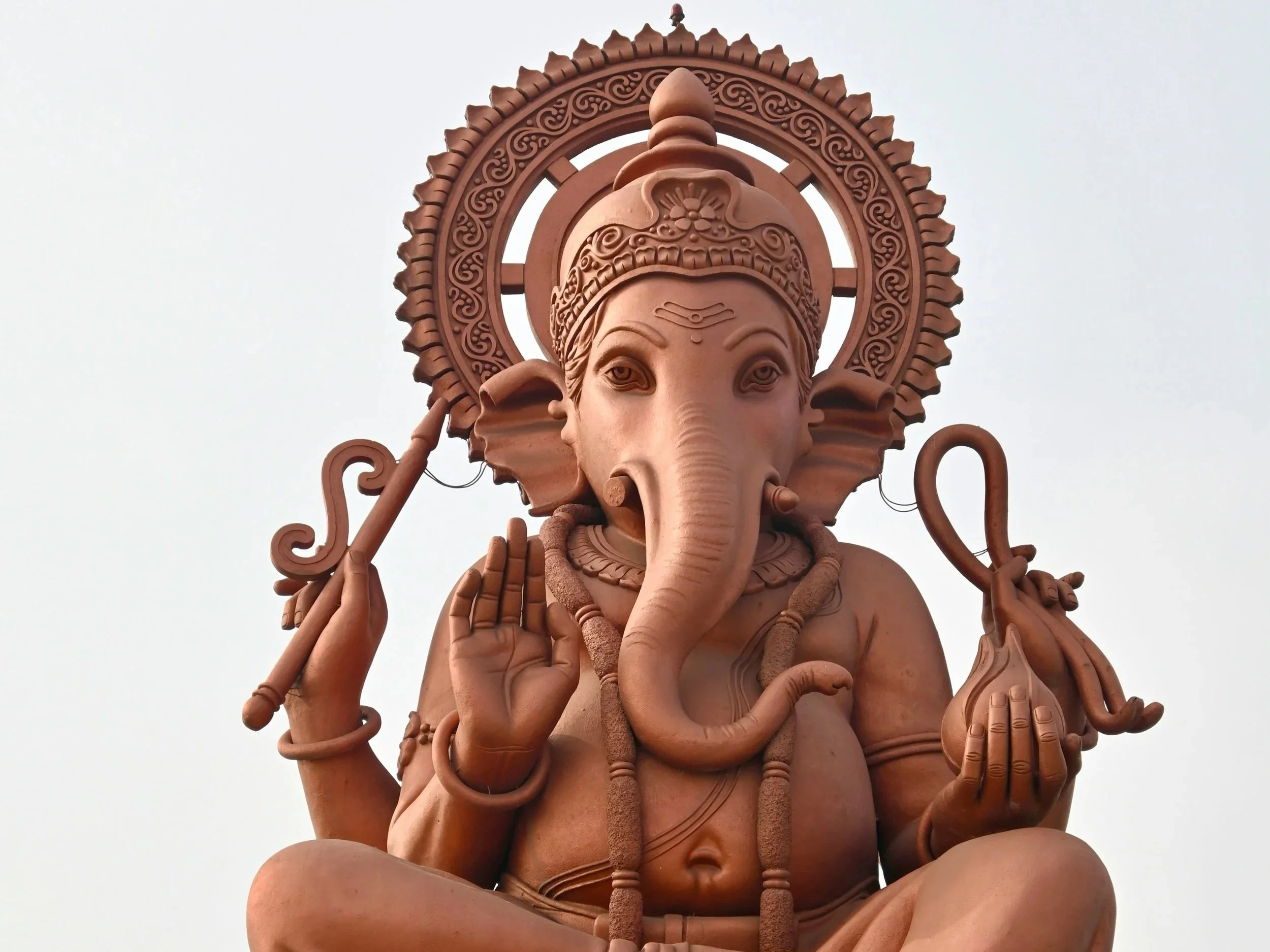
Photo by Jayanth Muppaneni on Unsplash
Om Gam Ganapataye Namah!
Hindus and yogis begin all undertakings with an invocation to Lord Ganesha, the elephant-headed deity, because he is the ‘remover of obstacles’ or the ‘obstacle to obstacles.’
And so, that is how I will begin this little reflection, coming as it does just after the annual festival of ‘Ganesh Chaturthi’ in honour of this charming deity.
Most of us know that Ganesha holds a broken tusk in one hand, incurred in removing the devotee’s obstacles. There is much more to Ganesha, his meaning is infinite really, but in keeping with the ‘Yoga Well’ we will reflect on Ganesha as the ‘keeper of wisdom’.
Ganesha is much loved in India. The pot-bellied, loveable young deity with an elephant’s head, four arms, holding a noose, an elephant goad, a handful of sweets or rice balls, as well as his broken tusk.
Around his belly is wound a belt or sacred cord in the form of a snake. There is always a little mouse at his feet; and often this large figure is, incongruously, seated on the mouse, as his vehicle.
In some depictions, he looks directly at you with disarmingly human, searching eyes.
Where I once considered Ganesha a humorous even childish figure, I have since grown to appreciate his beauty and power. Perhaps it is he who has removed the cataracts from my eyes.
There is such wonderful symbolism attached to Ganesha and it is best to ponder it for yourself and listen to what it says to you.
I like the idea of his noose (pasha) as a rope that binds us to his saving power. The goad (ankus) he holds is used to tame wild elephants, in this case the rebellious senses. His handful of sweets are the rewards of the spiritual efforts. His large ears listen to the appeals of the world.
Ganesha has a long-twisted trunk, associated with the curves of the symbol of the mantra ‘OM’.
The snake around his belly is a symbol of Kundalini. Ganesha is often depicted in a graceful dance shifting from foot to foot, awakening prana shakti.
Ganesha’s large paunch is the symbol of ‘Poorna’, the fullness of the whole universe, which he contains. And yet, paradoxically he sits on ‘mousaka’ a humble little mouse, the macrocosm astride the microcosm. This beautifully conveys the mystery of creation.
In another sense, the mouse symbolises the restless ever-breeding thoughts, gnawing away, insatiably trying to penetrate the tiniest crevices and secret places of the mind. Ganesha sits on the mouse of the mind and brings it to stillness.
Now, Ganesha is of course the son of Parvati and Shiva, and as such he combines the cosmic principles of creative energy (Shakti) and consciousness (Cit).
In south Indian traditions, he presides over the Muladhara Chakra and gives access to its dormant cosmic energies.
The name ‘Ganesha’ (Gana- Isha) means ‘Lord of the Ganas’. The Ganas symbolise, among many things, the dispersed mental energies. Ganesha, and his mantra, bring them under control and make the mind one-pointed.
The elephant is renowned for its intelligence and a memory that never forgets. Ganesha with his huge head is the keeper of the ‘akashic records’ from which the seers ‘download’ the secrets of Yoga.
When Rishi Vyasa was dictating the epic Mahabharata, he had Ganesha as his scribe. When the pen broke under the immensity of the task and the weight of meaning, Ganesha broke off a tusk and continued to write.
He therefore gives understanding of the yogic scriptures, and the ability to memorise and recite them with total fidelity.
Ganesha also represents intuitive, right-brained thinking. Many are the stories of his ingenuity. In one story, he has to compete with his brother, Lord Subramanian, in a race around the universe. Subramanian (the linear thinker) sets off at high speed, but Ganesha simply performs a little circumambulation on his mouse around Shiva and Parvati, because they ‘are my universe’, and he wins the golden mango.
Because of his association with intelligence, Lord Ganesha is invoked in pursuit of learning and developing academic proficiency. There is a ritual called ‘Thoppukaranam’ which from ancient times has been used in India to help slow learners, activate the brain, balance the brain hemispheres and to enhance cognitive intelligence.
In front of a statue of Lord Ganesha, one takes hold of the left earlobe with the right hand, and the right earlobe with the left hand and performs a series of squats (exhaling as you come down and inhaling as you come up). Like all Yogic practices, this must be performed with ‘bhava’, in the right spirit and with respect.
This is all just a little portion of the yogic secrets of Lord Ganesha, the elephant-headed deity who sits on a mouse!
May Lord Ganesha continue to inspire our sadhana.
Jai Sri Ganesha!
Yogacharya Michael McCann
(Acknowledgements to the inspired teaching of Dr. Ananda Balayogi Bhavanani, Rishiculture Ashtanga Yoga)
