
Mantra Yoga
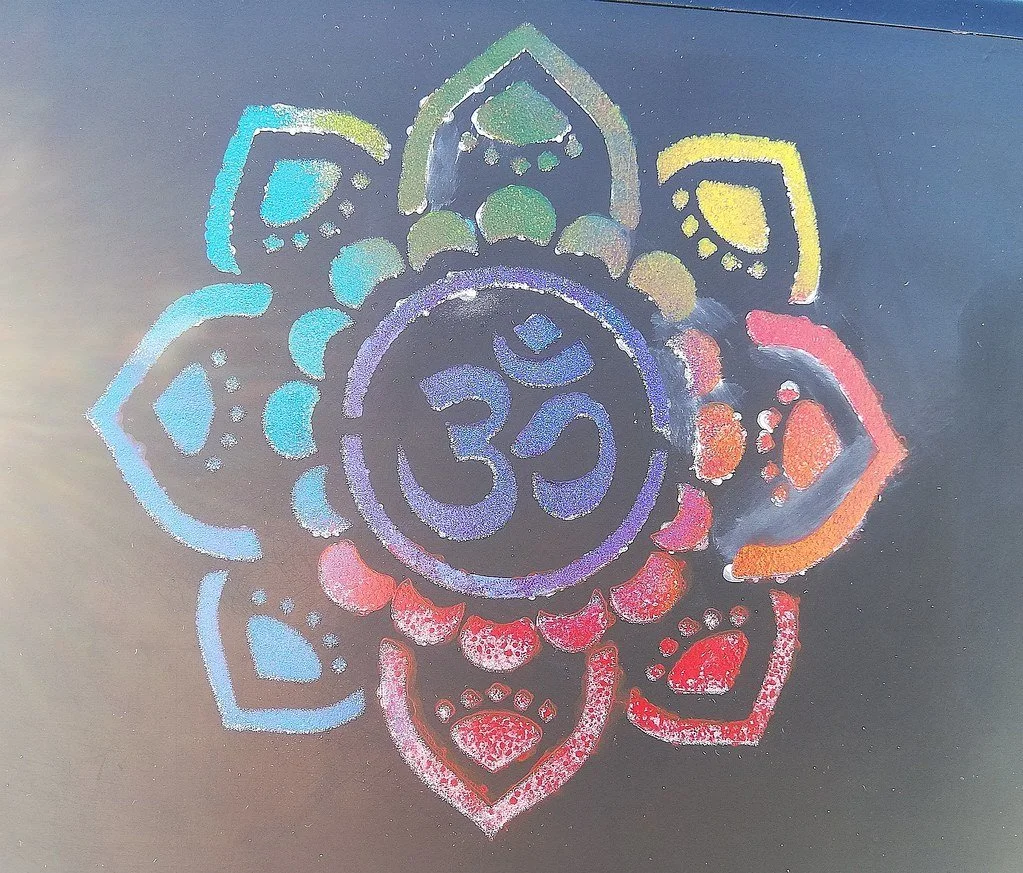
Photo by Luca Carloni on Flickr
“Mananat Trayate Iti Mantrah” (the Repetition of Mantra Liberates from the Bondage of Maya).
The word “Mantra” comes from the Sanskrit “manas” meaning “mind” and “trayoti” meaning “to protect or to liberate”. In essence, mantra is a means to protect or liberate the mind from gross influences, such as negativity, stress, and turbulence and has therefore many psychological benefits.
However, the main purpose of mantra is spiritual, to liberate us from ignorance (avidya) and identification with the mind and the ego. This is the aim of Yoga; to help us realise our true identity as Atman, or the Higher Self.
Saint John’s Gospel begins “In the beginning was the Word, the Word was God and the Word was with God”. We find the same truth in more ancient Hindu scripture: “In the beginning was Brahman, and the Word was Brahman, and the Word was with Brahman”.
The Word of the Bible is the “Shabda Brahman” of Tantra, the “Sound of Brahman” or “Sound of God”. The mantra OM is of course this Word, from which comes “Amen” associated with Jesus, the Word.
According to Tantra, the Shabda Brahman brings creation into manifestation. This sound manifested as vibrational waves or Nada Brahman “the Vibration of the Absolute Underlying Consciousness”; this eventually became the 50 sounds of the Sanskrit alphabet, which create the world as name and form.
Modern science has recently discovered an “unheard vibration”, a low-level background noise or energy constant throughout the universe, an echo of the Big Bang, the latter being the Shabda Brahman!
Now, if sound can create gross forms, it also can create spiritual states, and many Sanskrit mantras bring the chanter into those states. This is the spiritual dimension of mantra. The mantra OM is the most sacred of all the Sanskrit mantras and is chanted to unfold our spiritual potential and to achieve the divine union that is Yoga.
Yoga teaches that the mantras existed in the primaeval ether and were perceived by the Rishis or seers in deep meditation and then passed on in the form of words.
There are many mantras of different types and purposes: Krishna mantras, Shiva mantras, Durga and Kali mantras, healing mantras, prayer mantras, wisdom mantras, mantras for power, and more. These fall into the following categories: Bija (seed sounds), Bhakti (devotional), Maha Vakya (Great Utterances), Upchara (healing ) and Siddha (attainment mantras).
Swami Radha describes mantra as “a combination of sacred syllables which forms a nucleus of spiritual energy; this serves as a magnet to attract or a lens to focus spiritual vibrations”. Eknath Easwaran states that “a mantra is a powerful spiritual formula, which when repeated silently in the mind, has the capacity to transform consciousness”. A mantra is mystical energy encased in a sound structure.
Mantra is chanted in four different ways.
Vakya japa- uttered aloud
Upanshu japa-whispered
Manasic japa- repeated mentally
Sahaja japa- spontaneous repetition in the mind or heart centre.
Mantra can also be written, and this is known as “Likhita Japa”. When we repeat mantras, the practice is known as “japa”. This word comes from “ja” (birth) and “pa” (sin, ignorance, or indeed karma). Therefore, japa helps to release us from karma and helps us go beyond spiritual ignorance. Japa promotes pratyahara and prepares us for meditation; it also helps us to confront and exhaust inner conflicts and negative currents in the subconscious. The exhaustion of the mental dross is essential in awakening Awareness.
In the mantra tradition, the sacred word is repeated, using beads (a mala or rosary). A mala of 108 beads is used, which is a sacred number in Yoga. The number 1 represents Oneness, Unity or Totality. The number 8 represents the human personality and indeed the manifest universe. The number zero in between proclaims that there is no difference between the One and the multiple manifestation, God and the Universe. Japa utilises rounds of derivatives of 108, such as 27 and 54. These numbers uniquely total the number 9, which symbolises the perfection of human life, the aim of Yoga.
There is a mala of 27 beads, known as the “sumirani mala”, which is used for doing japa throughout the day.
In a mala the beads are separated from each other by a special knot called a Brahma Granthi (the knot of Brahma). The mala is shaped like a coiled snake or a cow tail, with an extra bead, known as the “sumeru” (the summit). This is used as the starting and ending part of the rotations and allows the adept to count rounds.
The mala is held in the right hand, unless the practitioner is left-handed. The hand is held in front of the heart or resting on the right knee. The mala is turned in a certain way and the index and little fingers are not used, and this is most easily and effectively learned from a teacher.
OM TAT SAT.
Michael McCann
